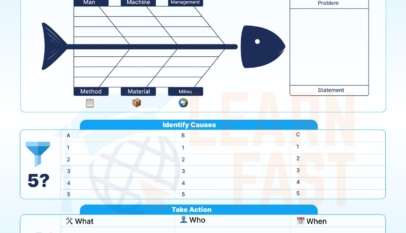
The $1.8 Million Surprise
The COO of a 700-person tech firm called me with a blunt question:
“We just spent $1.8 million on Lean training for our entire workforce. Everyone knows the theory, the terms, the principles. But after all this? Our metrics haven’t moved an inch. Why?”
When I visited their headquarters, it was clear they hadn’t cut corners:
- Four months of intensive Lean and Kaizen training
- Every team completed problem-solving certification
- Digital improvement boards installed on every floor
- Monthly innovation meetings scheduled company-wide
- Suggestion platforms buzzing with ideas
Yet, six months later, nothing changed: Delivery timelines? Same. Customer ratings? Unchanged. Employee engagement? Flat as ever.
The truth? They didn’t have a training problem. They had a psychology problem.
Warning Signs in Plain Sight
I sat in on an engineering improvement meeting. Sophia, the team lead, kicked things off:
“Any areas where we can improve this week?”
- Liam: “Build deployments are taking 5 hours instead of 90 minutes.”
- Aisha: “Bug reports come way too late in the cycle.”
- Jordan: “Our approval chain is slowing design down.”
Sophia enthusiastically noted all of it… then wrapped up with, “Great discussion. Let’s circle back next week!”
The following Thursday? Same list. No ownership, no deadlines, no action.
When I asked Liam privately, he said, “We’ve talked about this for two months, but no one’s given the green light to actually fix it.”
Later, in customer support, the story repeated. The manager, Elena, explained: “We could easily cut response time from 36 hours to 12 if we integrated better with engineering. But urgent projects always come first.”
When I asked executives about their improvement goals, their answers were vague: “We just want better performance across the board.”
That’s when I realized—they didn’t lack knowledge. They lacked five critical psychological enablers.
The Five Missing Psychological Elements
Here’s what I uncovered—and why most Kaizen programs fail without these:
1. Clear Purpose
What I saw: People solving problems without linking them to business impact.
Psychology: If the “why” isn’t clear, improvement feels optional.
Example: Liam thought slow deployments were just inconvenient—until we revealed the hidden cost: $10,000 a week in wasted hours. His urgency tripled.
2. Required Capabilities
What I saw: Teams trained on paper, never coached in real-world scenarios.
Psychology: Theory without application creates false confidence—and eventual burnout.
Example: Aisha had memorized root cause steps but froze when tackling a real bug-flow issue. Guided practice changed that.
3. Adequate Resources
What I saw: Improvement treated as an add-on to already overloaded jobs.
Psychology: If improvement feels like extra work, people will avoid it.
Example: Elena’s team managed 150 tickets daily with zero time carved out for process changes. No wonder nothing moved.
4. Clear Action Plan
What I saw: Meetings full of ideas, but zero ownership or timelines.
Psychology: Without structure, momentum dies.
Example: Sophia’s group identified the same issues for eight weeks straight with no action items or accountability.
5. Measurement and Monitoring
What I saw: Leadership goals like “be more efficient” instead of measurable targets.
Psychology: If people can’t see progress, motivation evaporates.
Example: Their customer rating sat at 7.4 out of 10. Was 7.6 a win? 8.0? No one knew.
How They Turned It Around
We launched one pilot to prove the model using Liam’s deployment challenge:
- Purpose: Reduce deployment costs by $10,000/week
- Capability: Guided the team through hands-on root cause work
- Resources: Dedicated 3 hours/week to improvement work
- Action: Assigned owners, deadlines, and milestones
- Metrics: Goal—cut deployment time from 5 hours to 90 minutes
Six weeks later:
- Deployment down to 75 minutes
- Rework costs cut by 65%
- Team morale boosted significantly
Three months later:
- 15 active improvement projects
- Employee engagement up 20%
- Customer score improved from 7.4 to 8.3
The COO called me last month: “That $1.8 million is finally showing returns—but only because we fixed the psychology, not just the process.”
The takeaway? Continuous Improvement isn’t just a toolkit. It’s a mindset shift built on purpose, capability, resources, structure, and measurement. Without those, even the best training won’t move the needle.



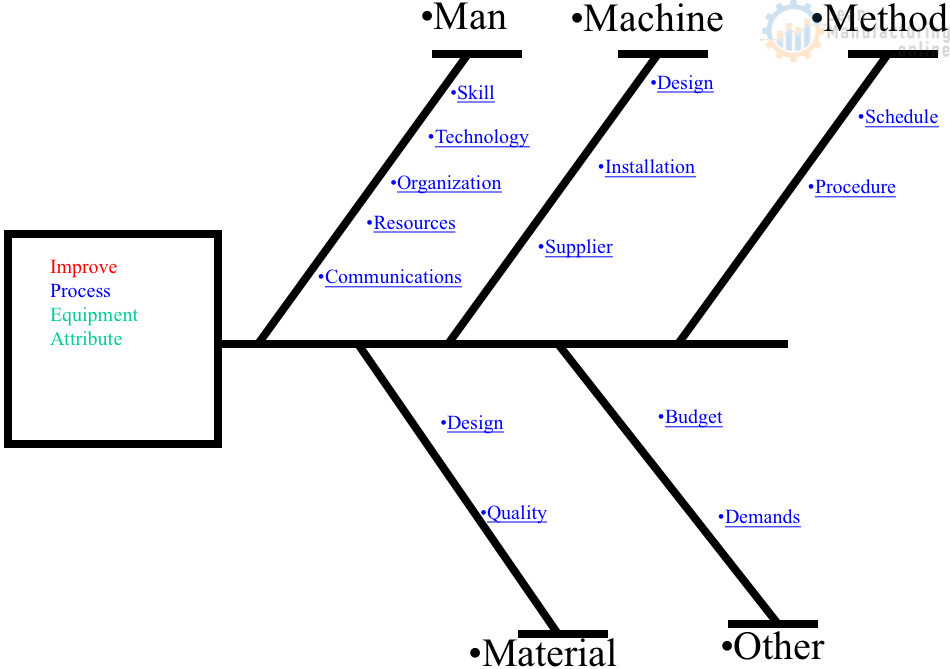
4M Analysis Process: Root Cause Guide for Manufacturing
Learn how to use 4M Analysis to find manufacturing root causes across People, Machine, Method, and Material with diagrams, examples, and checklist.