Manufacturing is no longer limited to machines running in isolation, operators checking gauges by hand, and decisions being made only after a problem appears. Today, factories are becoming more connected, more intelligent, and far more responsive. At the center of this shift is IIoT, or the Industrial Internet of Things.
IIoT is the use of smart, connected sensors, devices, and machines in industrial environments to collect, exchange, and analyze data in real time. In simple terms, it helps machines communicate, sends their data to the right systems, and turns that information into action. This is what transforms a traditional factory into a smart factory.
In a conventional setup, many assets operate like separate islands. A machine may generate valuable data, but if that data stays locked inside the equipment or on a local control panel, its value is limited. IIoT changes that. It makes machines talk, helps systems think through analytics and AI, and enables operations to act faster and smarter.
When IIoT is implemented well, several things begin to happen at once. Machines communicate data continuously. Information is stored and analyzed instead of being lost or ignored. Decisions become faster and more automated. Efficiency improves. Productivity rises. Quality becomes easier to control. These outcomes are exactly why IIoT has become such an important part of modern manufacturing and Industry 4.0.
What IIoT Really Means on the Shop Floor
The idea of IIoT can sound highly technical, but its purpose is practical. It connects the physical world of machines, sensors, and equipment with the digital world of software, cloud platforms, dashboards, and analytics.
That connection matters because factories generate enormous amounts of data every day. Motors produce vibration signals. Lines consume electricity. Pumps create flow and pressure readings. Assembly tools record torque values. Temperature changes, speed fluctuations, current patterns, and idle time all tell a story about performance.
Without IIoT, much of that story remains hidden. With IIoT, the data becomes visible, useful, and actionable.
This visibility allows teams to move from reacting to problems toward preventing them. Instead of waiting for a breakdown, the system can warn that a bearing is likely to fail. Instead of discovering a defect at final inspection, it can detect an assembly issue in real time. Instead of finding out at the end of the month that energy costs are too high, it can flag waste while machines are still running.
That is the real promise of IIoT in manufacturing: turning raw machine signals into timely decisions.
Practical Uses of IIoT in Manufacturing
One of the strongest reasons manufacturers adopt IIoT is that it solves real operational problems. The image highlights three highly practical and industry-relevant uses.
Predictive Maintenance
Predictive maintenance is one of the most widely recognized applications of IIoT. In this approach, sensors measure conditions such as vibration, temperature, current, and pressure. These signals are monitored continuously so abnormal patterns can be detected early.
Instead of maintaining equipment only at fixed intervals, or waiting until it fails, manufacturers can use actual machine condition to predict when intervention is needed. AI and analytics help identify patterns that may not be obvious to the human eye. A rising vibration trend, a subtle temperature increase, or a change in electrical current can all indicate that a failure is developing.
A practical example is a motor vibration sensor predicting bearing failure weeks before the breakdown occurs. That extra warning time can make a major difference. Maintenance can be scheduled. Spare parts can be arranged. Production can avoid an unplanned stop. Costs go down, uptime goes up, and the maintenance team shifts from firefighting to control.
Quality Monitoring and Traceability
Quality is another major area where IIoT creates value. Sensors can measure critical parameters such as torque, pressure, speed, and temperature during production. These measurements help verify that each process step stays within the required conditions.
This becomes even more powerful when product data is linked directly to process data. Every unit produced can carry a digital history of how it was made. That creates full traceability, which is especially valuable in automotive, aerospace, electronics, food, pharmaceuticals, and other industries where quality assurance and compliance are essential.
A clear example is the use of torque sensors in assembly. If a fastener is missing or not tightened correctly, the system can detect it immediately. That allows the defect to be prevented before it moves downstream. Instead of relying only on end-of-line inspection, the process itself becomes smarter and more reliable.
This is a major mindset shift. Quality is no longer just checked after production. It is monitored during production.
Energy Monitoring and Optimization
Energy is often treated as an overhead cost, but IIoT helps turn it into a controllable performance metric. Smart meters can measure electricity, compressed air, water, and gas usage in real time. This matters because many factories lose money not only through poor production performance, but also through invisible energy waste.
IIoT systems can generate alerts when abnormal energy consumption appears. For example, if a machine is running idle but still drawing excessive power, the system can flag it against a benchmark. That creates an opportunity to reduce waste immediately.
This kind of monitoring supports both cost control and sustainability goals. It helps manufacturers identify which assets consume more than expected, when waste occurs, and where improvement efforts should be focused. In other words, it moves energy management from guesswork to data-driven action.
The Simple IIoT Architecture and Flow of Information
To understand how IIoT works, it helps to look at its basic architecture. The image presents a four-layer structure that explains how information travels from the machine to decision-makers.
1. Sensors and Devices, the OT Layer
The first layer is the physical world, often called the OT, or Operational Technology, layer. This includes the devices installed directly on machines and processes. Common examples include vibration sensors, temperature sensors, flow sensors, pressure sensors, smart meters, and PLC or CNC controllers.
Their main purpose is to collect raw machine data. They are the starting point of IIoT because they capture what is actually happening in real time. If the equipment changes condition, the sensor data changes with it.
This layer is essential because no digital system can create insight without accurate input from the physical process.
2. Edge Gateway, the OT to IT Bridge
The second layer is the edge gateway, which acts as the bridge between OT and IT. This layer is often described as the brain between the machine and the cloud because it converts sensor data into a format that digital systems can use more easily.
Its functions typically include protocol conversion, such as translating Modbus or OPC-UA into MQTT or HTTP. It can also filter and clean data, perform basic analytics, and send only meaningful information onward. That helps reduce noise and improves efficiency.
This layer matters because industrial equipment often speaks a different language than modern IT platforms. The edge gateway allows older and newer systems to work together. It is a critical step in making machine data usable at scale.
3. Cloud or Platform Layer, the IT Layer
The third layer is the cloud or platform layer. This is where large volumes of machine data are stored, processed, and analyzed. Platforms such as AWS IoT and Azure IoT are common examples.
At this stage, the system begins to do more than simply collect information. It can organize data, run analytics, support machine learning, and detect patterns across assets, lines, or facilities. Historical trends become visible. Predictive models can be built. Performance comparisons become possible.
This is where data begins to turn into insight.
4. Applications Layer
The fourth layer is the applications layer, which is what users actually see. This includes dashboards, OEE parameters, predictive maintenance tools, smart factory or smart grid views, mobile alerts, results tracking, and prescriptive analytics.
This is the business-facing part of IIoT. It is where engineers, maintenance teams, supervisors, managers, and leaders interact with the information. Well-designed applications help people make faster and better decisions. They reveal what needs attention, where losses are happening, and what action should come next.
Without this final layer, even strong data collection would struggle to drive real operational improvement.
Why IIoT Is Needed Beyond Conventional Sensors and PLC Networking
Traditional PLC and sensor networks are valuable, but they have limits. In many cases, they are designed mainly to control machines and collect local data. That works for basic automation, but it often leaves manufacturers with limited analytics, limited remote visibility, and limited integration across the business.
IIoT goes further.
It connects machines to the cloud, enabling real-time monitoring across locations and systems. It supports predictive maintenance instead of reactive response. It enables advanced analytics instead of simple status viewing. It creates IT-OT integration, which means operational data can support wider business decisions, not just machine control.
It also provides richer data, remote access, and better scalability. These capabilities are especially important for Industry 4.0, where speed, flexibility, visibility, and intelligent automation are becoming competitive requirements.
Put simply, conventional systems help machines run. IIoT helps businesses learn from how machines run.
IIoT vs IoT: What Is the Difference?
The terms IoT and IIoT are closely related, but they are not the same.
IoT, or Internet of Things, is generally designed for consumer applications. This includes smart homes, wearable devices, and everyday automation. Its focus is usually convenience, comfort, and connected living.
IIoT, or Industrial Internet of Things, is designed for industrial environments such as manufacturing, energy, oil and gas, logistics, and utilities. Its focus is reliability, uptime, quality, traceability, safety, efficiency, and operational performance.
The technologies may look similar at first glance because both rely on connected devices and data exchange. The difference is in the environment, the expectations, and the stakes. In industry, performance failures can mean downtime, defects, lost production, compliance risk, or safety issues. That is why IIoT solutions are built for tougher conditions and more demanding outcomes.
The Bigger Opportunity for Manufacturers
IIoT is not just about adding sensors or sending data to the cloud. It is about building a smarter operating system for manufacturing. It allows organizations to see more clearly, respond more quickly, and improve more consistently.
A connected factory can monitor asset health, protect product quality, manage energy use, and support better decisions at every level. It can reduce downtime, improve uptime, strengthen traceability, and unlock more value from both machines and people.
For manufacturers pursuing operational excellence, IIoT offers a practical path forward. It helps bridge the gap between automation and intelligence. It turns isolated equipment into connected assets. And it creates the digital foundation needed to compete in a world where speed, quality, visibility, and adaptability matter more than ever.
The factories that make the best use of IIoT are not simply collecting more data. They are using better data to make better decisions.



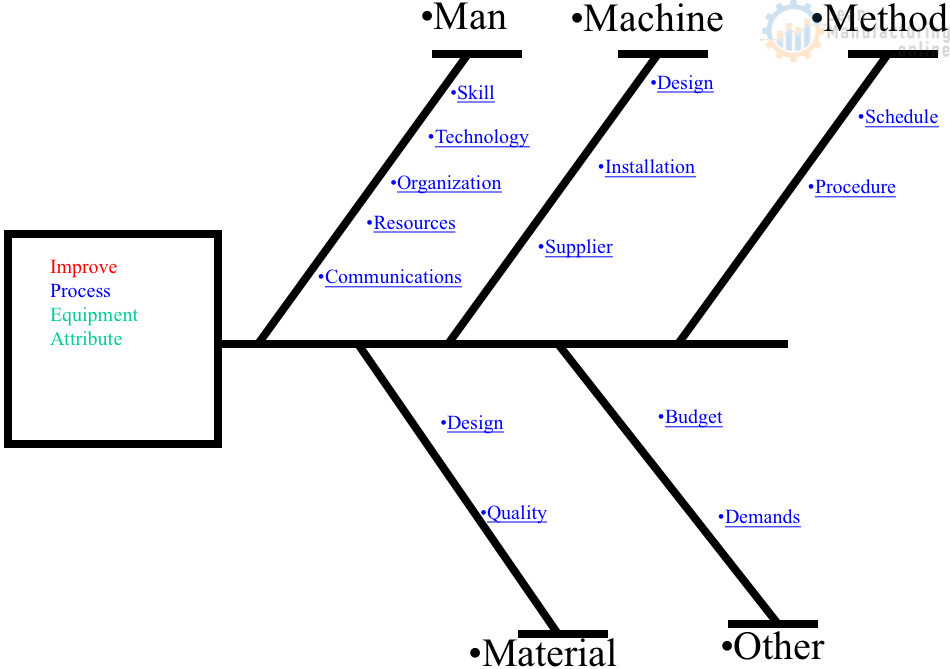
4M Analysis Process: Root Cause Guide for Manufacturing
Learn how to use 4M Analysis to find manufacturing root causes across People, Machine, Method, and Material with diagrams, examples, and checklist.