Lean Manufacturing

  • Lean Manufacturing
  • Home
  • Process Excellence
    • Lean Six Sigma
    • TPM
      • TPM Introduction
      • Change Management
      • Focused Improvement
      • Autonomous Maintenance
      • Education and Training
      • Quality
      • Safety, Health and Environment
      • Planned Maintenance
      • Early Equipment Management
    • TPS
    • Tools
      • Last Minute Travel Deals
      • 5 Why Analysis
      • Cap-Do
      • Kaizen
      • FMEA
      • One Point Lessons Directory
    • Templates
      • Machine Ledger
      • 5S Audit Checklist and Report
      • Cap-Do (PDCA)
      • One Point Lesson
      • FMEA template
      • M-P Sheet and EEM Template Guide
      • Why-Why Analysis
  • Free Courses
    • Lean Six Sigma White Belt Course
    • Lean Six Sigma Yellow Belt Course
    • Lean Six Sigma Green Belt Exam
    • Lean Six Sigma Black Belt Exam
    • TPM Instructor Course
    • Agile Retrospective: Continuous Improvement and Kaizen with Scrum
    • Autonomous Maintenance Facilitator
    • Planned Maintenance Facilitator
  • Submit a Post
  • Contact
Home TPM Instructor Training (page 2)

Instructor Training

  • Chapter 6. Planned (Effective) Maintenance. Part 2

    sensei December 1, 2020
    0 3,080
    Instructor Training Planned Maintenance TPM
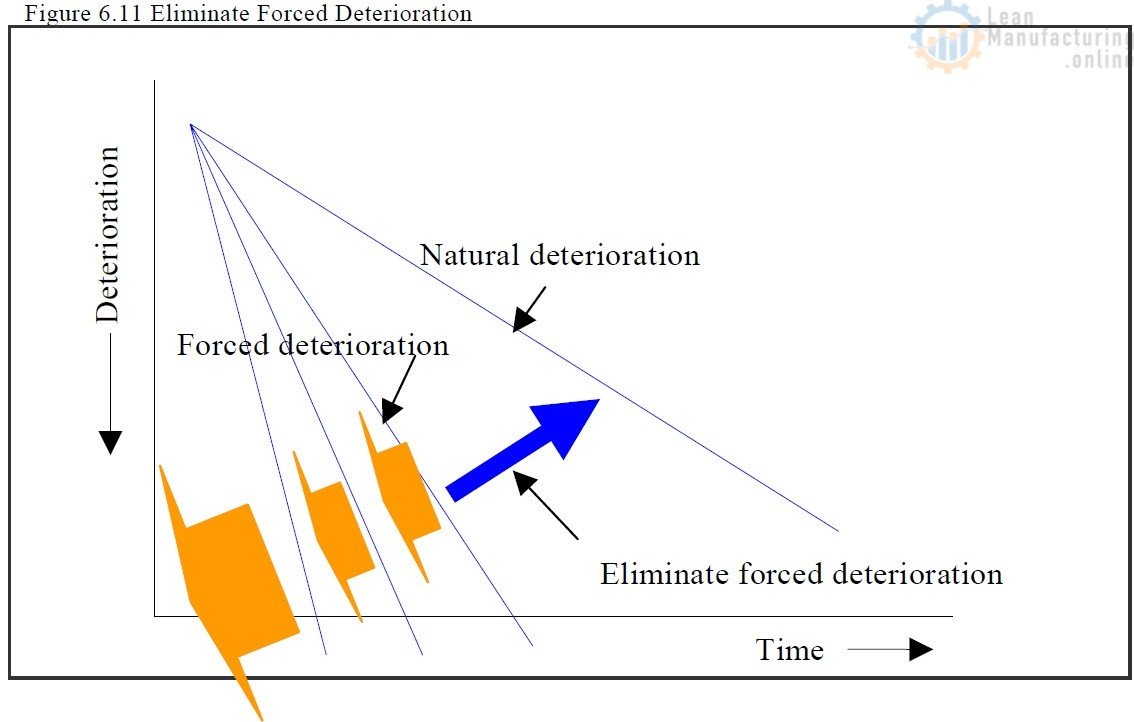
    Figure showing how to eliminate forced deterioration in TPM equipment management

    4. Carrying out Effective Maintenance 4.1 The Structure of Equipment Maintenance 4.2 Zero-failure Program 4.3 Prioritizing the Equipment and Selecting the Maintenance System

    Read More »
  • Chapter 6. Planned (Effective) Maintenance. Part 1

    sensei December 1, 2020
    0 7,989
    Instructor Training Planned Maintenance TPM

    1 What Is Effective Maintenance? 1.1 The Aim of Effective Maintenance Effective Maintenance aims to raise the company’s productivity by lowering the total cost of its equipment over every stage from design and fabrication through to operation and maintenance (including the initial cost of the equipment itself, maintenance and other…

    Read More »
  • Chapter 5. Autonomous Maintenance. Part 1

    sensei November 30, 2020
    2 24,811
    Autonomous Maintenance Instructor Training TPM

    1. Autonomous Maintenance: the Basic Approach 1.1 What is Autonomous Maintenance? (1) Operators should look after their own equipment Autonomous Maintenance aims to create a scenario where all operators look after their own equipment, carrying out routine checks, oiling and greasing, replacing parts, doing simple repairs, spotting problems at an…

    Read More »
  • Chapter 5. Autonomous Maintenance. Part 4

    sensei November 30, 2020
    0 2,984
    Instructor Training

    5. Reviewing the Autonomous Maintenance Steps 5.1 Autonomous Maintenance reviews An Autonomous Maintenance review is a coaching session carried out by a higher-level group in the overlapping small group pyramid in order to ensure that every member of the team under review has fully understood the purpose of the Autonomous…

    Read More »
Previous page Next page

Most Popular

4M Analysis fishbone diagram showing People, Machine, Method, and Material root cause categories

4M Analysis Process: Root Cause Guide for Manufacturing

sensei
August 29, 2018

Learn how to use 4M Analysis to find manufacturing root causes across People, Machine, Method, and Material with diagrams, examples, and checklist.
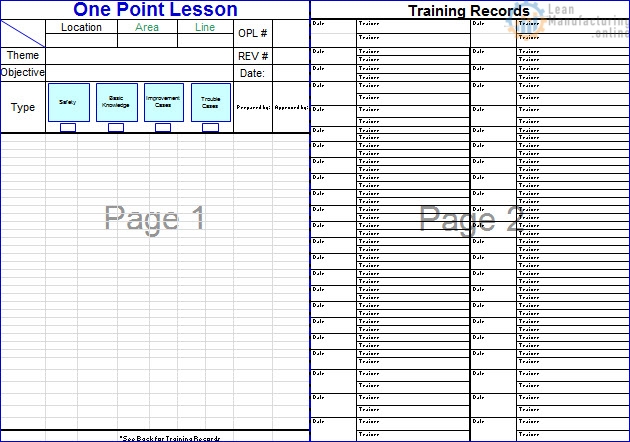

OPL – One Point Lesson Template – Free Download

sensei
November 5, 2018

PDCA – A Process Approach

sensei
January 8, 2023
5S checklist and audit visual standard for workplace organization

5S Audit Checklist and Report

sensei
April 18, 2022

Why-Why Analysis

sensei
June 10, 2022

Recent

PDCA and 5 Why workflow for Kaizen problem solving

4M Analysis Examples for Manufacturing Problems

Free Online Certificate Courses Worth Your Time This Year

Industrial Internet of Things in Manufacturing: Uses, Architecture, and Benefits

Why Quality Starts With Constancy of Purpose

Blog Search

Lean Manufacturing is a methodology for producing goods that emphasizes minimizing waste and maximizing efficiency. It is a manufacturing philosophy that aims to produce goods with the least amount of resources, time and effort. Lean manufacturing aims to eliminate waste and improve the flow of materials and information throughout the production process. This approach is often used in manufacturing environments where efficiency and cost-effectiveness are critical, such as in the automotive and electronics industries.
Copyright © 2026 leanmanufacturing.online
  • Terms of Use
  • Privacy Policy
  • About Our Ads

Popular Posts

4M Analysis fishbone diagram showing People, Machine, Method, and Material root cause categories

4M Analysis Process: Root Cause Guide for Manufacturing

sensei
August 29, 2018

Learn how to use 4M Analysis to find manufacturing root causes across People, Machine, Method, and Material with diagrams, examples, and checklist.

OPL – One Point Lesson Template – Free Download

sensei
November 5, 2018

PDCA – A Process Approach

sensei
January 8, 2023
5S checklist and audit visual standard for workplace organization

5S Audit Checklist and Report

sensei
April 18, 2022

Most Popular Tools

PDCA and 5 Why workflow for Kaizen problem solving

4M Analysis Examples for Manufacturing Problems

Toyota Production System with kaizen standardization jidoka and just in time

Kaizen Mindsets: 24 Principles for Lasting Change

Innovation vs. Kaizen Explained

How Kaizen and PMP Work Together