Imagine arriving at your holiday destination, collecting your luggage, and discovering that the rental car you reserved is already prepared and waiting in the parking lot.
There is only one problem.
You must wait two and a half hours before you can drive it away.
That was the challenge facing Toyota Rent a Car Okinawa near Naha Airport. Hundreds of vehicles could be ready for customers, yet the process connecting each customer to the correct car was slow, fragmented, and difficult to manage.
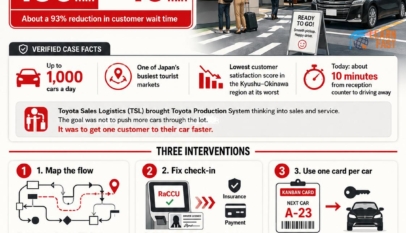
At its worst, customers waited as long as 150 minutes. Complaints increased, employees became overwhelmed, and the location recorded the lowest customer satisfaction score in the Kyushu–Okinawa region.
Today, the journey from the reception counter to driving away takes approximately 10 minutes.
Toyota reduced customer waiting time by approximately 93%.
The improvement did not come from simply hiring more employees, purchasing more vehicles, or pressuring staff to work faster.
Instead, Toyota examined the complete flow of customers, information, paperwork, keys, and cars. The team made the work visible, removed unnecessary waiting, introduced clearer signals, and created a process that continued operating even when someone made a mistake.
The Challenge at Toyota Rent a Car Okinawa
Toyota Rent a Car’s operation near Naha Airport serves one of Japan’s busiest tourist markets.
During peak periods, the location can handle up to 1,000 rental vehicles per day. Hundreds of cars may be positioned in the lot, ready to be collected by arriving customers.
However, the availability of cars did not guarantee a smooth customer experience.
Customers still had to move through reception, complete documentation, confirm insurance choices, present their driving licences, arrange payment, receive keys, locate the assigned vehicle, and leave the property.
Each step may appear simple when viewed individually. Together, however, they formed a complex service process involving:
- Customers arriving from the airport
- Front-desk and back-office employees
- Vehicle preparation teams
- Rental contracts and insurance documents
- Keys and parking locations
- Payment and identification systems
- Vehicle movement and dispatch signals
When these elements were not synchronized, waiting accumulated.
The car could be ready while the paperwork was not. The customer could complete check-in while staff were uncertain which vehicle should be moved next. A key could be available, but the vehicle location might not be immediately clear.
The real issue was not the number of cars in the parking lot.
The real issue was flow.
Toyota Sales Logistics: Applying TPS Beyond Manufacturing
Toyota is widely known for the Toyota Production System, commonly called TPS.
TPS is often associated with automotive manufacturing, assembly lines, Just-in-Time production, built-in quality, Kanban, standardized work, and waste elimination.
However, the principles are not limited to factories.
The Toyota Production System is fundamentally a way of designing work so that value moves smoothly to the customer while problems become visible and employees can respond quickly.
Toyota Sales Logistics, or TSL, applies the same thinking to sales and service operations.
Instead of focusing on the movement of parts through a factory, TSL examines the movement of customers, vehicles, documents, information, and services.
At Toyota Rent a Car Okinawa, the objective was not simply to process a greater number of rental cars.
The objective was to help each customer reach their car faster.
The customer does not care how busy each department is. The customer cares about how long it takes to receive the value they were promised.
Toyota introduced three major interventions:
- Mapping the complete process flow
- Improving and automating customer check-in
- Using a visual Kanban system to control vehicle preparation
1. Mapping How Customers, Cars, and Information Really Moved
The first intervention was process mapping.
Before changing the customer-facing operation, the team worked with Toyota’s TSL Promotion Division to document how customers, vehicles, paperwork, and information actually moved through the process.
This was not a theoretical map of how managers believed the process should operate.
It was a map of what truly happened.
The team examined the process step by step:
- Where did customers arrive?
- Where did they wait?
- What information did employees need?
- How were keys organized?
- When were vehicles requested?
- Who decided which car should be prepared next?
- Which decisions depended on personal judgement?
- Where did work stop?
This exercise exposed problems that had remained hidden because employees had accepted them as normal parts of the job.
That is one of the greatest advantages of process mapping.
Waste frequently becomes invisible to the people who experience it every day. Employees learn to work around broken systems by creating shortcuts, spreadsheets, handwritten notes, verbal signals, personal reminders, and informal rules.
These workarounds may keep the operation functioning, but they also hide weaknesses in the underlying process.
At Toyota Rent a Car Okinawa, process mapping revealed:
- Unnecessary movement of vehicles
- Unclear preparation priorities
- Inconsistent working methods
- Repeated or duplicated activities
- Dependence on employee memory
- Vehicles being prepared too early
- Work being completed in the wrong sequence
For example, employees might prioritize vehicles that would not be rented until the following day. Cars could also be washed again after rain, creating extra work without helping the next customer leave sooner.
The same problem exists in many industries.
A hospital patient may wait even when an examination room is available. A customer order may sit in a queue even when the product is in stock. A maintenance technician may wait for approval even when the required part is ready.
In each case, value exists, but the flow is interrupted.
2. Improving Check-In With RaCCU
The second major intervention focused on customer check-in.
Toyota introduced an automated check-in system called RaCCU.
The machine can scan the customer’s driving licence and support important parts of the rental process, including:
- Identity and licence verification
- Insurance selection
- Payment processing
- Completion of rental documentation
This allows customers to complete much of the required paperwork without waiting for a traditional service counter.
The automated check-in process can be completed in approximately three minutes.
Technology Alone Was Not Enough
Introducing technology does not automatically improve a process.
A self-service system creates value only when customers understand it, trust it, and use it.
Initially, adoption of the RaCCU machines was limited. Many customers continued to follow familiar habits and approach the service counter.
Toyota therefore addressed the adoption problem directly.
A short instructional video was shown on the airport shuttle bus before customers arrived at the rental location. The video explained how the automated process worked and prepared customers to use it.
Arrow stickers were also placed on the floor to guide arriving customers toward the RaCCU machines.
These were small and inexpensive improvements, but they reduced uncertainty and made the desired process easier to follow.
At the Naha Airport Seaside Shop, RaCCU usage increased to 87%.
The lesson: Installing technology is not the same as achieving adoption. People need clear guidance at the moment they are expected to use the new process.
3. Using One Kanban Card to Control Each Vehicle
The third intervention addressed vehicle preparation and dispatch.
Several hundred cars could be parked and ready for customers. Managing that inventory required a clear method for deciding:
- Which vehicle should be prepared next
- Where each vehicle should be positioned
- Which key and contract belonged to each customer
- When the next vehicle should be replenished
- Whether the preparation process was falling behind
Toyota introduced a simple analog Kanban system.
Each ready vehicle was represented by a card or clipboard containing the necessary information, such as the vehicle category, key, contract details, and preparation status.
When the customer received the key and contract, the Kanban became empty.
That empty card became the signal authorizing employees to prepare the next required vehicle.
This is a classic pull-system principle.
Work is triggered by actual demand rather than guesswork.
Instead of employees preparing vehicles based on intuition, assumptions, or personal preference, the Kanban showed exactly what the operation required next.
Why the Kanban System Worked
The Kanban system made the condition of the process visible.
Employees could immediately see:
- Which vehicles were ready
- Which vehicle category needed replenishment
- What should be prepared next
- Whether the process was running behind
- When additional support was required
The system also reduced dependence on employee memory.
This is particularly important in operations involving experienced staff, new employees, temporary workers, and part-time employees.
A strong process should not require one highly experienced person to remember everything. The required information should be visible and available to anyone performing the work.
Toyota also reorganized the parking lot according to how frequently different vehicles were rented. High-demand vehicles could be positioned more conveniently, reducing unnecessary movement and transportation.
Together, the Kanban system and improved lot arrangement reduced vehicle dispatch time from approximately seven minutes to four minutes per car.
A three-minute improvement may appear small when viewed as a single transaction.
Multiplied across hundreds or potentially 1,000 vehicles per day, it represents a significant reduction in labour, movement, congestion, and customer waiting.
Why the Live Test Was More Important Than a Perfect Demonstration
Toyota Times documented a live test of the improved process.
During the test, a staff member accidentally directed the reporter to the wrong vehicle.
In many organizations, this type of mistake would cause confusion. Employees might stop the process, search for a supervisor, blame another department, repeat paperwork, or ask the customer to return to the service counter.
Instead, the Toyota process continued to function.
The mistake did not cause the entire system to collapse.
The reporter was still able to drive away approximately eight minutes after completing check-in.
A strong process is not one in which people never make mistakes. It is one that helps people detect, correct, and recover from mistakes quickly.
This detail may be more valuable than a perfect demonstration.
A weak process works only when experienced employees make perfect decisions.
A strong process remains stable when normal human errors occur.
Nobody Added Staff. They Removed the Waiting.
One of the most powerful lessons from this case is that Toyota did not solve the problem by simply adding more employees.
Additional staffing can sometimes reduce waiting, but it can also increase cost while leaving the underlying process unchanged.
If work is poorly organized, adding employees may create more handoffs, communication, movement, and confusion.
Toyota instead removed the causes of waiting.
- The team clarified the complete process flow.
- It reduced dependence on the reception counter.
- It improved customer guidance.
- It introduced a visual replenishment signal.
- It organized vehicles according to demand.
- It reduced dependence on memory.
- It made abnormal conditions easier to see.
The improvement was not about forcing people to work faster.
It was about making the work easier to understand and execute.
This is one of the central principles of Lean management.
Speed should come from improved flow, not increased pressure.
How to Apply These Lessons in Your Organization
The same principles can be applied far beyond rental-car operations.
Begin by selecting one customer journey with visible waiting, recurring complaints, missed deadlines, or excessive employee frustration.
Follow the process from the customer’s initial request to the moment value is delivered.
Observe what actually happens rather than relying only on procedures, reports, or assumptions.
Questions to Ask During the Review
- Where does the customer wait?
- Where does information wait?
- Where do employees depend on memory?
- Where are priorities unclear?
- Which steps could be completed before the customer arrives?
- Which activities could be automated?
- What guidance would help customers use the automation?
- What visual signal could show the team what to do next?
- What work is being completed too early?
- How quickly can the process recover when an error occurs?
Avoid beginning with a large technology project.
Toyota used automation for check-in, but it also used simple tools such as floor arrows, shuttle-bus videos, cards, clipboards, boxes, and improved parking arrangements.
The objective is not to introduce the most advanced solution.
The objective is to create the clearest and most reliable flow.
The Customer Notices Waiting Before the Organization Does
Customers experience every delay as part of the service.
They do not separate waiting caused by reception, paperwork, approvals, systems, scheduling, vehicle preparation, or internal communication.
To them, it is one continuous experience.
That is why leaders must examine performance from the customer’s perspective.
Toyota Rent a Car Okinawa already had vehicles in the parking lot.
The cars were not the problem.
The process connecting each customer to the correct car was the problem.
By mapping the flow, improving check-in, and introducing a visual Kanban pull system, Toyota reduced a 150-minute wait to approximately 10 minutes.
The case demonstrates that continuous improvement does not always require large investments or dramatic transformation programs.
Sometimes, the most powerful improvements come from:
- Making the work visible
- Guiding people clearly
- Removing unnecessary movement
- Reducing dependence on memory
- Using real customer demand to trigger work
- Designing processes that recover quickly from mistakes
Where in your business would the customer notice the waiting before you did?
Source: Toyota Times case study on Toyota Rent a Car Okinawa and the Naha Airport Seaside Shop.
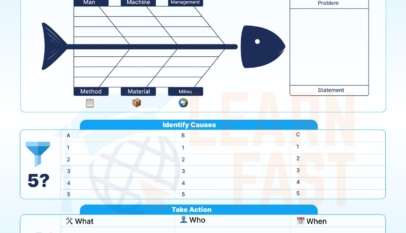


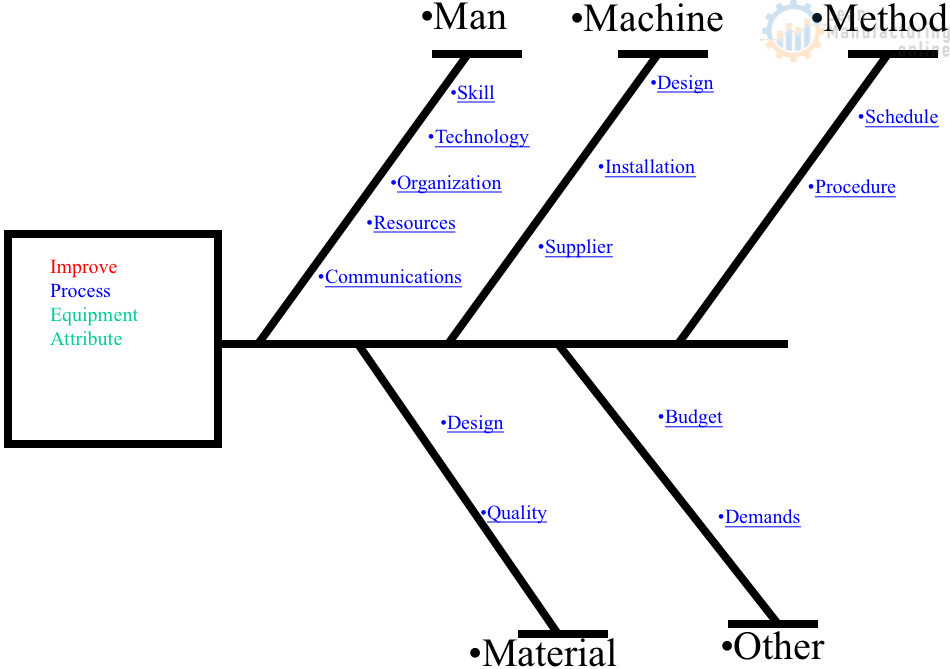
4M Analysis Process: Root Cause Guide for Manufacturing
Learn how to use 4M Analysis to find manufacturing root causes across People, Machine, Method, and Material with diagrams, examples, and checklist.