Enhancing Your Business Performance

  • Enhancing Your Business Performance
  • Home
  • Process Excellence
    • Lean Six Sigma
    • TPM
      • TPM Introduction
      • Change Management
      • Focused Improvement
      • Autonomous Maintenance
      • Education and Training
      • Quality
      • Safety, Health and Environment
      • Planned Maintenance
      • Early Equipment Management
    • TPS
    • Tools
      • Last Minute Travel Deals
      • 5 Why Analysis
      • Cap-Do
      • Kaizen
      • FMEA
      • One Point Lessons Directory
    • Templates
      • Machine Ledger
      • 5S Audit Checklist and Report
      • Cap-Do (PDCA)
      • One Point Lesson
      • FMEA template
      • M-P sheet (EEM) free template download
      • Why-Why Analysis
  • Free Courses
    • Lean Six Sigma White Belt Course
    • Lean Six Sigma Yellow Belt Course
    • Lean Six Sigma Green Belt Exam
    • Lean Six Sigma Black Belt Exam
    • TPM Instructor Course
    • Agile Retrospective: Continuous Improvement and Kaizen with Scrum
    • Autonomous Maintenance Facilitator
    • Planned Maintenance Facilitator
  • Submit a Post
  • Contact

Innovation vs. Kaizen Explained

June 7, 2025
0 2,557 4 min read

Innovation vs. Kaizen: Choosing the Right Approach to Improvement

In the world of performance improvement, two powerful approaches often dominate conversations: Innovation and Kaizen. Both offer pathways to better results—but they couldn’t be more different in how they get there.

Innovation is bold. It’s about big bets and major shifts. Kaizen, on the other hand, is humble. It values the power of incremental, steady progress.

Understanding when to use each is crucial for leaders, teams, and organizations aiming to thrive in a competitive world.

What Is Innovation? The High-Impact Route

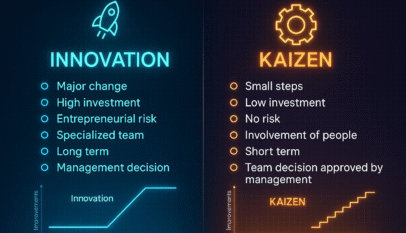
Innovation represents disruptive, game-changing transformation. Think of it as launching a rocket—it requires fuel (investment), coordination (a specialized team), and direction (management backing).

  • Major change: Often redefines the way work is done
  • High investment: Capital, time, and human resources
  • Entrepreneurial risk: Not all bets pay off
  • Specialized team: Experts lead the charge
  • Long-term focus: Results take time to realize
  • Top-down decision-making: Driven by leadership

Use innovation when you’re ready to make a leap forward—not just a step ahead. Ideal for breakthrough product development, digital transformation, or reimagining your customer experience.

What Is Kaizen? The Power of Consistent Small Wins

Kaizen is built on the belief that every small improvement adds up. It’s the sum of everyday decisions made better—by the people doing the work.

  • Small steps: Tiny changes repeated over time
  • Low investment: Often no cost at all
  • No risk: Easy to test, easy to adapt
  • People-powered: Everyone contributes
  • Short-term focus: Immediate feedback loops
  • Team-driven: Approved with management support

Kaizen works best when looking for sustainable, team-led efficiency. It’s perfect for process optimization, 5S improvements, or daily problem-solving in operations.

How to Choose: Innovation or Kaizen?

Choosing between Innovation and Kaizen isn’t about picking a “better” method—it’s about choosing what fits the moment.

Choose Innovation when:

  • You face disruptive market changes
  • You’re aiming for long-term differentiation
  • Your idea requires major tech or process overhaul

Choose Kaizen when:

  • You want consistent progress
  • Your team is closest to the process
  • You’re building a culture of continuous improvement

Best Practice? Many high-performing organizations blend both. They use Kaizen to build momentum and engagement—and Innovation to make bold moves when it matters most.

Let your improvement strategy match the challenge. Whether you’re looking to scale a mountain or take daily steps, understanding the difference between Kaizen and Innovation is how you get there with confidence.
Tagsbreakthrough changeContinuous improvementInnovationKaizenLean ManufacturingOperational ExcellenceProcess Improvementproductivity boostsmall steps big impactteam engagement
Share
  • Share on Facebook
  • Share on Twitter
  • Reddit
  • Linkedin
Previous article Mastering the Toyota Way: 14 Principles That Drive Operational Excellence
Next article Why OLE Is the Missing Link in Lean

sensei

  • More By sensei
  • More In Kaizen
Artificial Intelligence Continuous Improvement Lean Lean Manufacturing Lean Six Sigma Productivity Safety TPM World Class Manufacturing
November 19, 2025
0 650

Gemba Walk GPT: The Smartest Way to Turn Observations Into Real Improvement

Business Consulting Lean Lean Manufacturing Lean Six Sigma
November 16, 2025
0 1,335

How to Create a Step-by-Step Reveal Animation in PowerPoint

Book reviews Continuous Improvement Leadership and Continuous Improvement Lean Manufacturing Lean Six Sigma
October 4, 2025
0 2,797

Explore the Best Free Online Libraries in 2025

TPM
October 3, 2025
0 2,740

TPM Master Plan: The Roadmap to World-Class Manufacturing

Continuous Improvement Data Science
October 3, 2025
0 1,049

Exploring Statistical Software: Features, Costs, and Flexibility

Continuous Improvement Leadership and Continuous Improvement Lean Manufacturing
September 29, 2025
0 2,479

How to Use Dashboards to Drive Shop Floor Result

Continuous Improvement Kaizen
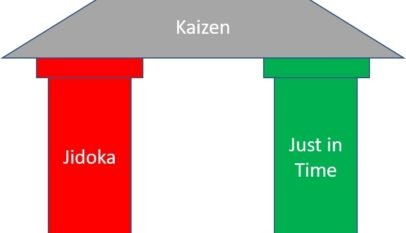
Toyota Production system. Jidoka and Just-in-Time are two pillars of TPS.
August 17, 2025
0 1,791

How to Drive Lasting Change with Kaizen Mindsets

Kaizen
June 7, 2025
0 2,557

Innovation vs. Kaizen Explained

Blog Kaizen Project Management
April 7, 2025
0 2,007

How Kaizen and PMP Work Together

Blog Focused Improvement Kaizen PM-analysis
November 23, 2024
0 6,111

Identifying Phenomena for Minor Stops – 6 Gens

Blog Kaizen
developgoodhabits.com
March 22, 2023
0 6,713

Kaizen Event Planning in 7 Simple Steps

Blog Kaizen
January 9, 2023
0 2,568

Uncovering the Secrets of Kaizen Events: What You Need to Know!

Most Popular

4M Analysis Process

sensei
August 29, 2018

The purpose of this procedure is to define the steps to do a 4M …

OPL – One Point Lesson Template – Free Download

sensei
November 5, 2018

PDCA – A Process Approach

sensei
January 8, 2023
5S - Sort, Set, Shine, Standardize, Sustain

5S Audit Checklist and Report

sensei
April 18, 2022

Why-Why Analysis

sensei
June 10, 2022

Recent

Gemba Walk GPT: The Smartest Way to Turn Observations Into Real Improvement

How to Create a Step-by-Step Reveal Animation in PowerPoint

Explore the Best Free Online Libraries in 2025

TPM Master Plan: The Roadmap to World-Class Manufacturing

Blog Search

Lean Manufacturing is a methodology for producing goods that emphasizes minimizing waste and maximizing efficiency. It is a manufacturing philosophy that aims to produce goods with the least amount of resources, time and effort. Lean manufacturing aims to eliminate waste and improve the flow of materials and information throughout the production process. This approach is often used in manufacturing environments where efficiency and cost-effectiveness are critical, such as in the automotive and electronics industries.
Copyright © 2025 leanmanufacturing.online
  • Terms of Use
  • Privacy Policy
  • About Our Ads

Popular Posts

4M Analysis Process

sensei
August 29, 2018

The purpose of this procedure is to define the steps to do a 4M …

OPL – One Point Lesson Template – Free Download

sensei
November 5, 2018

PDCA – A Process Approach

sensei
January 8, 2023
5S - Sort, Set, Shine, Standardize, Sustain

5S Audit Checklist and Report

sensei
April 18, 2022

Most Popular Tools

Toyota Production system. Jidoka and Just-in-Time are two pillars of TPS.

How to Drive Lasting Change with Kaizen Mindsets

Innovation vs. Kaizen Explained

How Kaizen and PMP Work Together

Root Cause Analysis Stacking: A Game-Changer for Problem Solving