Lean Manufacturing

  • Lean Manufacturing
  • Home
  • Process Excellence
    • Lean Six Sigma
    • TPM
      • TPM Introduction
      • Change Management
      • Focused Improvement
      • Autonomous Maintenance
      • Education and Training
      • Quality
      • Safety, Health and Environment
      • Planned Maintenance
      • Early Equipment Management
    • TPS
    • Tools
      • Last Minute Travel Deals
      • 5 Why Analysis
      • Cap-Do
      • Kaizen
      • FMEA
      • One Point Lessons Directory
    • Templates
      • Machine Ledger
      • 5S Audit Checklist and Report
      • Cap-Do (PDCA)
      • One Point Lesson
      • FMEA template
      • M-P sheet (EEM) free template download
      • Why-Why Analysis
  • Free Courses
    • Lean Six Sigma White Belt Course
    • Lean Six Sigma Yellow Belt Course
    • Lean Six Sigma Green Belt Exam
    • Lean Six Sigma Black Belt Exam
    • TPM Instructor Course
    • Agile Retrospective: Continuous Improvement and Kaizen with Scrum
    • Autonomous Maintenance Facilitator
    • Planned Maintenance Facilitator
  • Submit a Post
  • Contact
Home Blog (page 72)

Blog

  • Five Causes of Equipment Breakdowns

    sensei February 17, 2019
    0 10,992
    Autonomous Maintenance Blog Planned Maintenance

    When equipment breaks down it is necessary to find root cause of the problem. Let’s review five main causes. Forced Deterioration These breakdowns are caused by: Lack of Cleaning (accumulation of Dirt and Dust);Lack of Inspection (e.g. loose nuts, bolts, etc);Lack of Lubrication. Lack of Basic Conditions (CIL) ! What…

    Read More »
  • Breakdown Recurrence Matrix

    sensei December 23, 2018
    0 4,041
    Blog
    Following the legend, fill out the matrix for forced deterioration breakdowns only.

    It is a tool that tracks all breakdowns, analysis and countermeasures in one matrix. What does Recurrence Matrix does do? Tracks forced deterioration breakdowns by week;Tracks when a breakdown analysis is done;Tracks when countermeasures are applied. What do we need to build the matrix? 2 things are needed to build the matrix:…

    Read More »
  • Principle of Operation – Analysis Diagram

    sensei December 12, 2018
    0 14,976
    Blog Focused Improvement Lean Six Sigma
    Conveyor Belt Parts Diagram.

    One of the important steps to identify the Root Cause is an understanding of the process and equipment. To start, create a sketch of the machine or component, where you saw the problem occurred. The second step is to identify the Ideal Sequence of Movement, e.g. Pickoff arms move up->Solenoid…

    Read More »
  • Broken Parts Museum – Analyzing and Preventing Breakdowns due to Forced Deterioration

    sensei December 9, 2018
    1 3,391
    5 Why Analysis Autonomous Maintenance Blog OPL Root Cause Analysis Training World Class Manufacturing
    Training for AM Teams to Prevent Reoccurrence of FD Breakdowns

    Collecting broken or worn machine parts for later analysis will help to understand root cause of failures, as well as can assist with training AM team members. Training for AM Teams to Prevent Reoccurrence of Forced Deterioration Breakdowns Use Actual Broken Parts to Demonstrate FD breakdowns to AM teams to…

    Read More »
Previous page Next page

Most Popular

4M Analysis Process

sensei
August 29, 2018

The purpose of this procedure is to define the steps to do a 4M …

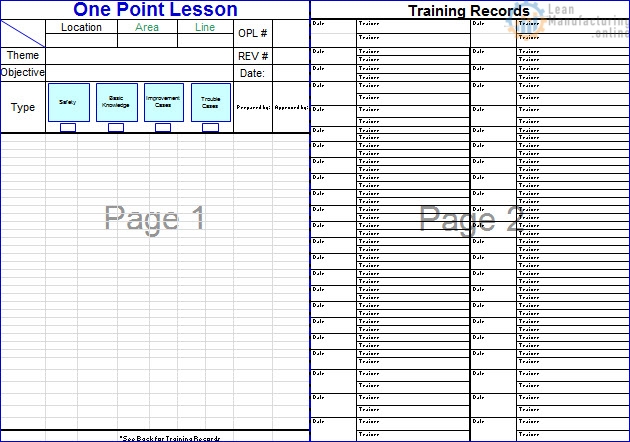
OPL – One Point Lesson Template – Free Download

sensei
November 5, 2018

PDCA – A Process Approach

sensei
January 8, 2023
5S - Sort, Set, Shine, Standardize, Sustain

5S Audit Checklist and Report

sensei
April 18, 2022

Why-Why Analysis

sensei
June 10, 2022

Recent

Free Online Certificate Courses Worth Your Time This Year

Industrial Internet of Things in Manufacturing: Uses, Architecture, and Benefits

Why Quality Starts With Constancy of Purpose

Six Sigma vs Lean Six Sigma: A Practical Guide

Blog Search

Lean Manufacturing is a methodology for producing goods that emphasizes minimizing waste and maximizing efficiency. It is a manufacturing philosophy that aims to produce goods with the least amount of resources, time and effort. Lean manufacturing aims to eliminate waste and improve the flow of materials and information throughout the production process. This approach is often used in manufacturing environments where efficiency and cost-effectiveness are critical, such as in the automotive and electronics industries.
Copyright © 2026 leanmanufacturing.online
  • Terms of Use
  • Privacy Policy
  • About Our Ads

Popular Posts

4M Analysis Process

sensei
August 29, 2018

The purpose of this procedure is to define the steps to do a 4M …

OPL – One Point Lesson Template – Free Download

sensei
November 5, 2018

PDCA – A Process Approach

sensei
January 8, 2023
5S - Sort, Set, Shine, Standardize, Sustain

5S Audit Checklist and Report

sensei
April 18, 2022

Most Popular Tools

Toyota Production system. Jidoka and Just-in-Time are two pillars of TPS.

How to Drive Lasting Change with Kaizen Mindsets

Innovation vs. Kaizen Explained

How Kaizen and PMP Work Together

Root Cause Analysis Stacking: A Game-Changer for Problem Solving