Lean Manufacturing

  • Lean Manufacturing
  • Home
  • Process Excellence
    • Lean Six Sigma
    • TPM
      • TPM Introduction
      • Change Management
      • Focused Improvement
      • Autonomous Maintenance
      • Education and Training
      • Quality
      • Safety, Health and Environment
      • Planned Maintenance
      • Early Equipment Management
    • TPS
    • Tools
      • Last Minute Travel Deals
      • 5 Why Analysis
      • Cap-Do
      • Kaizen
      • FMEA
      • One Point Lessons Directory
    • Templates
      • Machine Ledger
      • 5S Audit Checklist and Report
      • Cap-Do (PDCA)
      • One Point Lesson
      • FMEA template
      • M-P sheet (EEM) free template download
      • Why-Why Analysis
  • Free Courses
    • Lean Six Sigma White Belt Course
    • Lean Six Sigma Yellow Belt Course
    • Lean Six Sigma Green Belt Exam
    • Lean Six Sigma Black Belt Exam
    • TPM Instructor Course
    • Agile Retrospective: Continuous Improvement and Kaizen with Scrum
    • Autonomous Maintenance Facilitator
    • Planned Maintenance Facilitator
  • Submit a Post
  • Contact
Home Blog (page 84)

Blog

  • Inspection Steps for Chains and Sprockets – Visual Standards Inspections

    sensei April 25, 2018
    5 8,438

    Step 1:  Clean the sprocket with a rag touching and observing the sprocket. Step 2: Look for the following abnormalities:  Worn teeth Misalignment Abnormality 1: Worn teeth teeth should not be rounded,teeth should not be chipped. Abnormality 2: Misalignment The sprocket must be aligned and perfectly perpendicular to the axis of…

    Read More »
  • TPM and its Recent Trends

    sensei April 22, 2018
    0 2,592
    Blog TPM
    Equipment-Related Losses

    1. What is TPM? ‘TPM’ stands for ‘Total Productive Maintenance.’ It began with equipment maintenance and PM (preventive care) in particular. It was subsequently developed into a systematic approach for entire production sites, eventually appearing under TPM in Japan in 1971. In the subsequent three decades, it has helped increase…

    Read More »
  • TPM and its Recent Trends. Part 2

    sensei April 22, 2018
    0 2,697
    Blog
    Physical Analysis of Phenomenon

    3. TPM Techniques (Principally Quality Maintenance) The basic thinking behind the techniques used in TPM to reduce equipment losses and reverse deterioration is to apply physical principles and parameters (such as principles of processing). This contrasts with the approach used in TQM (typically, in SQC), where potential causes are analysed…

    Read More »
  • Millwrights and Mechanics Guide. Drawing and Sketching. Part 1

    sensei April 22, 2018
    2 6,954
    Blog Mechanic Millwright Planned Maintenance

    Drawings and sketches are universally used to communicate technical information. They are the graphic language used by everyone concerned with mechanical operations. They convey information, size, location, accuracy, etc.; and by their use, mechanisms ranging from the simple to the most complex can be graphically described. It is a universal…

    Read More »
Previous page Next page

Most Popular

4M Analysis Process

sensei
August 29, 2018

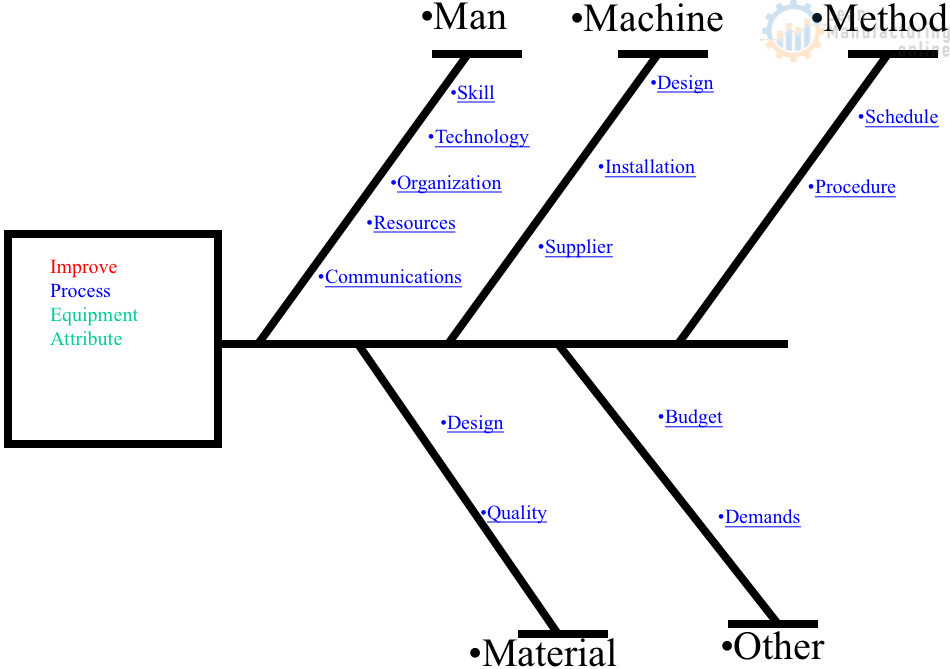
The purpose of this procedure is to define the steps to do a 4M …

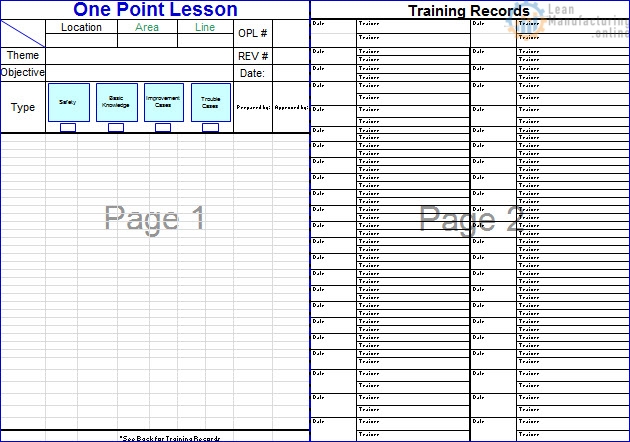
OPL – One Point Lesson Template – Free Download

sensei
November 5, 2018

PDCA – A Process Approach

sensei
January 8, 2023
5S - Sort, Set, Shine, Standardize, Sustain

5S Audit Checklist and Report

sensei
April 18, 2022

Why-Why Analysis

sensei
June 10, 2022

Recent

Free Online Certificate Courses Worth Your Time This Year

Industrial Internet of Things in Manufacturing: Uses, Architecture, and Benefits

Why Quality Starts With Constancy of Purpose

Six Sigma vs Lean Six Sigma: A Practical Guide

Blog Search

Lean Manufacturing is a methodology for producing goods that emphasizes minimizing waste and maximizing efficiency. It is a manufacturing philosophy that aims to produce goods with the least amount of resources, time and effort. Lean manufacturing aims to eliminate waste and improve the flow of materials and information throughout the production process. This approach is often used in manufacturing environments where efficiency and cost-effectiveness are critical, such as in the automotive and electronics industries.
Copyright © 2026 leanmanufacturing.online
  • Terms of Use
  • Privacy Policy
  • About Our Ads

Popular Posts

4M Analysis Process

sensei
August 29, 2018

The purpose of this procedure is to define the steps to do a 4M …

OPL – One Point Lesson Template – Free Download

sensei
November 5, 2018

PDCA – A Process Approach

sensei
January 8, 2023
5S - Sort, Set, Shine, Standardize, Sustain

5S Audit Checklist and Report

sensei
April 18, 2022

Most Popular Tools

Toyota Production system. Jidoka and Just-in-Time are two pillars of TPS.

How to Drive Lasting Change with Kaizen Mindsets

Innovation vs. Kaizen Explained

How Kaizen and PMP Work Together

Root Cause Analysis Stacking: A Game-Changer for Problem Solving