Lean Manufacturing

  • Lean Manufacturing
  • Home
  • Process Excellence
    • Lean Six Sigma
    • TPM
      • TPM Introduction
      • Change Management
      • Focused Improvement
      • Autonomous Maintenance
      • Education and Training
      • Quality
      • Safety, Health and Environment
      • Planned Maintenance
      • Early Equipment Management
    • TPS
    • Tools
      • Last Minute Travel Deals
      • 5 Why Analysis
      • Cap-Do
      • Kaizen
      • FMEA
      • One Point Lessons Directory
    • Templates
      • Machine Ledger
      • 5S Audit Checklist and Report
      • Cap-Do (PDCA)
      • One Point Lesson
      • FMEA template
      • M-P Sheet and EEM Template Guide
      • Why-Why Analysis
  • Free Courses
    • Lean Six Sigma White Belt Course
    • Lean Six Sigma Yellow Belt Course
    • Lean Six Sigma Green Belt Exam
    • Lean Six Sigma Black Belt Exam
    • TPM Instructor Course
    • Agile Retrospective: Continuous Improvement and Kaizen with Scrum
    • Autonomous Maintenance Facilitator
    • Planned Maintenance Facilitator
  • Submit a Post
  • Contact
Home TPM (page 87)

TPM

  • Chapter 11. Safety, Health and Environment. Part 2

    sensei October 19, 2017
    2 3,434
    Instructor Training Safety Safety, Health and Environment

    2.8 Using Safety Tags and Maps (1) Safety tags If an on-site safety inspection reveals a hazard, but nothing is done about it, the inspection will have served no purpose. Also, if the hazard is not clearly indicated, a person doing a safety check at a later date will not…

    Read More »
  • Chapter 11. Safety, Health and Environment. Part 1

    sensei October 19, 2017
    0 5,034
    Instructor Training Safety Safety, Health and Environment

    1. The Importance of Safety, Health and the Environment 1.1 An Overview of SHE The particular activities undertaken within a SHE programme will depend to a great extent on the prevailing attitudes toward safety, health and the environment in the company and the local community. Because of this, TPM does…

    Read More »
  • Chapter 10. TPM in Administrative and Support Departments. Part 2

    sensei October 15, 2017
    0 3,799
    Instructor Training Manufacturing Support

    3. Implementing Administrative Focused Improvements 3.1 What are Focused Improvements? Whereas Autonomous Maintenance in administrative and support departments is aimed at remedial action (i.e. restoring the situation to what it was before it deteriorated), Focused Improvements are all about innovation. What is more, Autonomous Maintenance is weighted towards current administrative…

    Read More »
  • Chapter 9. Education and Training (Training and Development). Part 2

    sensei October 12, 2017
    0 3,720
    Education and Training Instructor Training

    Autonomous Maintenance Practitioner Test Curriculum Subjects, Main Topics and Sub-Topics of Written Examination Table 9.6 Autonomous Maintenance Practitioner Test Curriculum Key: N/A – not applicable Overview – outline knowledge (true/false) General – general knowledge (4-choice) Detail – detailed knowledge (fill in the blanks) Subjects and Main Topics of Practical Examination…

    Read More »
Previous page Next page

Most Popular

4M Analysis fishbone diagram showing People, Machine, Method, and Material root cause categories

4M Analysis Process: Root Cause Guide for Manufacturing

sensei
August 29, 2018

Learn how to use 4M Analysis to find manufacturing root causes across People, Machine, Method, and Material with diagrams, examples, and checklist.
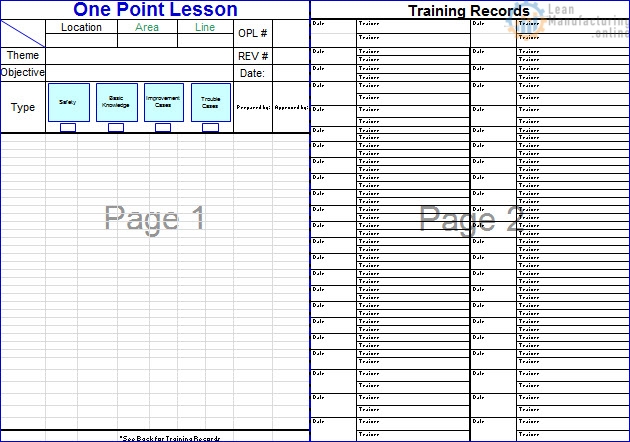
OPL – One Point Lesson Template – Free Download

sensei
November 5, 2018

PDCA – A Process Approach

sensei
January 8, 2023
5S checklist and audit visual standard for workplace organization

5S Audit Checklist and Report

sensei
April 18, 2022

Why-Why Analysis

sensei
June 10, 2022

Recent

Toyota’s Rental Car Kaizen Success

PDCA and 5 Why workflow for Kaizen problem solving

4M Analysis Examples for Manufacturing Problems

Free Online Certificate Courses Worth Your Time This Year

Industrial Internet of Things in Manufacturing: Uses, Architecture, and Benefits

Blog Search

Lean Manufacturing is a methodology for producing goods that emphasizes minimizing waste and maximizing efficiency. It is a manufacturing philosophy that aims to produce goods with the least amount of resources, time and effort. Lean manufacturing aims to eliminate waste and improve the flow of materials and information throughout the production process. This approach is often used in manufacturing environments where efficiency and cost-effectiveness are critical, such as in the automotive and electronics industries.
Copyright © 2026 leanmanufacturing.online
  • Terms of Use
  • Privacy Policy
  • About Our Ads

Popular Posts

4M Analysis fishbone diagram showing People, Machine, Method, and Material root cause categories

4M Analysis Process: Root Cause Guide for Manufacturing

sensei
August 29, 2018

Learn how to use 4M Analysis to find manufacturing root causes across People, Machine, Method, and Material with diagrams, examples, and checklist.

OPL – One Point Lesson Template – Free Download

sensei
November 5, 2018

PDCA – A Process Approach

sensei
January 8, 2023
5S checklist and audit visual standard for workplace organization

5S Audit Checklist and Report

sensei
April 18, 2022

Most Popular Tools

PDCA and 5 Why workflow for Kaizen problem solving

4M Analysis Examples for Manufacturing Problems

Toyota Production System with kaizen standardization jidoka and just in time

Kaizen Mindsets: 24 Principles for Lasting Change

Innovation vs. Kaizen Explained

How Kaizen and PMP Work Together