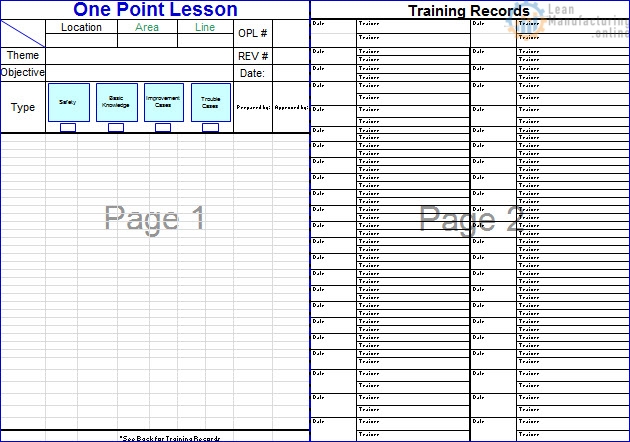
Electrical Safety One Point Lessons help manufacturing teams remember one clear safety point at the place where the risk may be seen. This page focuses on electrical panels and the basic rule that panels and switches should remain closed unless qualified, authorized work is being performed.
Important: this is an awareness-level OPL support page. It is not an electrical work procedure, lockout procedure, troubleshooting guide, or authorization to open an electrical panel. Always follow your site Health & Safety rules, electrical safety program, LOTO procedure, OEM instructions, and local legal requirements.
For related safety systems, see Lockout Tagout LOTO, Safety One Point Lessons, and Safety F-Tags.
What this electrical safety OPL teaches
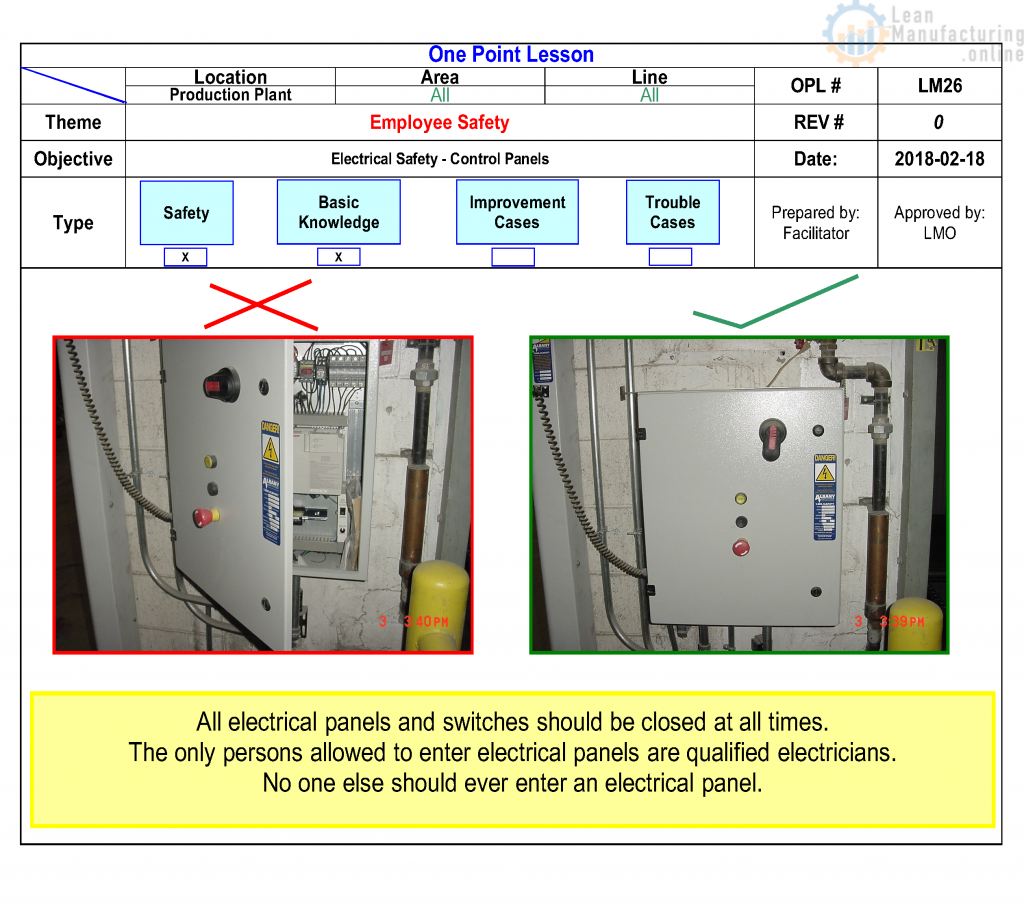
The point of this OPL is simple: electrical panels are not ordinary storage cabinets or inspection points. They may contain hazardous energy, energized parts, arc flash risk, and controls that should only be handled by qualified and authorized people.
A good electrical safety OPL should not try to teach unqualified people how to work inside a panel. It should help everyone recognize the boundary, respect the hazard, and escalate the issue to the right person.
Electrical panel safety reminders
| Reminder | Why it matters | Correct reaction |
|---|---|---|
| Keep panels closed | Open panels can expose people to electrical hazards. | Close the panel if safe and authorized, or report/escalate. |
| Qualified access only | Electrical work requires proper training and authorization. | Do not enter the panel unless qualified and assigned. |
| Use approved LOTO | Hazardous energy must be controlled before work. | Follow the site LOTO procedure and authorized-person rules. |
| Respect warning labels | Labels communicate shock, arc flash, voltage, or access risks. | Stop and ask a qualified person when unsure. |
| Report abnormal conditions | Missing covers, damage, heat, smell, water, or exposed wiring can indicate risk. | Use the site escalation process or Safety F-tag system. |
Qualified and authorized work only
Electrical panel work should be performed only by people who are qualified, trained, authorized, and working under the correct procedure. Operators, cleaners, mechanics, and supervisors should not open or enter panels unless they are specifically qualified and authorized for that task.
This is especially important during troubleshooting, cleaning, inspection, adjustment, maintenance, or restart activity. If the task changes, the condition is unclear, or the panel does not match the expected standard, stop and escalate.
Electrical safety and LOTO
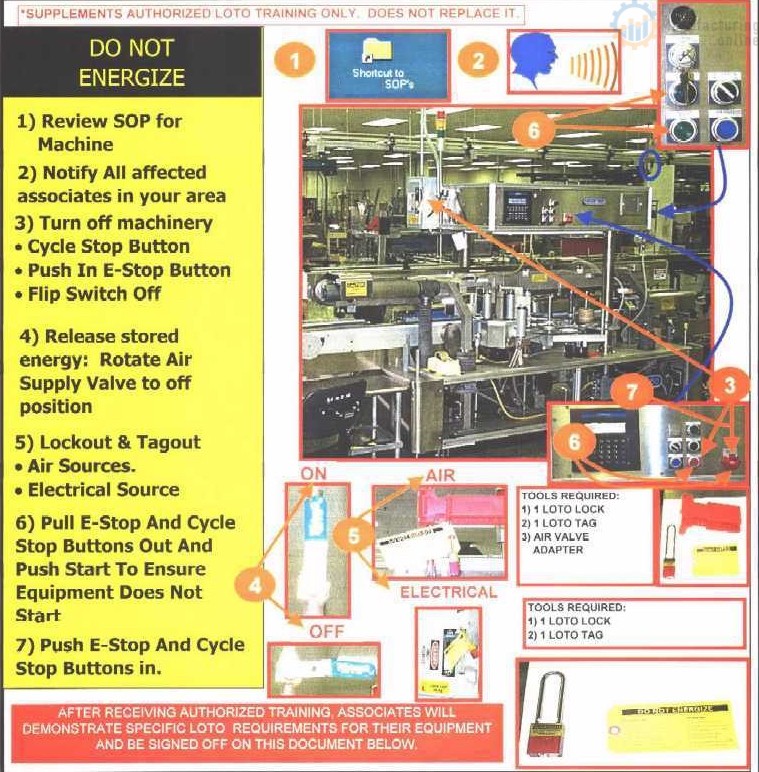
Electrical panel risks are closely connected to hazardous energy control. Before any work begins, the correct procedure must define how energy is isolated, controlled, verified, and released. A simple OPL can remind the team that LOTO exists, but it cannot replace the official procedure.
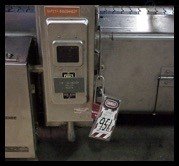
Locked and tagged disconnects
A locked and tagged disconnect communicates that equipment is controlled and must not be operated. The tag should make ownership clear, and the lockout condition must be respected by everyone in the area.
Locks and tags are visual controls
Locks and tags are visible parts of a larger safety system. They help people see that equipment is not available for use, but the protection comes from the complete system: authorization, procedure, communication, isolation, verification, and release rules.

PPE and qualified risk assessment
Electrical PPE is not a guess. Requirements should come from the site electrical safety program, the task risk assessment, and qualified review. A visual OPL can remind the team that PPE matters, but it should not decide PPE requirements by itself.

Electric shock awareness
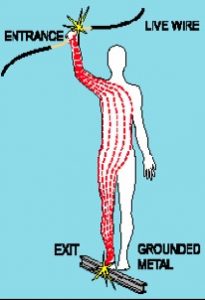
Electric shock can occur when a person becomes part of an electrical path. This is one reason panels should remain closed, damaged cords should be reported, and electrical abnormalities should be escalated quickly.
Arc flash awareness
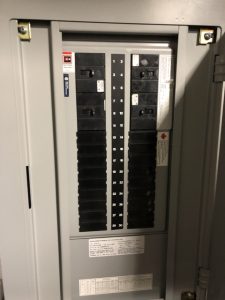
Arc flash is a serious electrical hazard. Teams should treat electrical panels with respect, avoid unauthorized access, keep warning labels visible, and escalate damaged, missing, or unclear labeling to the correct electrical safety owner.
Using an OPL for electrical safety
An electrical safety OPL should teach one point only. Good topics include “keep panels closed,” “qualified access only,” “report damaged electrical equipment,” “do not block panels,” or “escalate missing labels.” The OPL should be reviewed by the appropriate Health & Safety and electrical owner before posting.
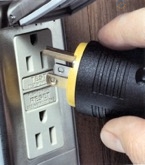
What should be included in an electrical safety OPL?
- One clear safety point
- A photo or visual from the actual workplace when possible
- The safe condition and the unsafe condition
- The required reaction: stop, report, tag, escalate, or call a qualified person
- A reminder that the OPL does not replace electrical training or LOTO procedures
- Reviewer or owner approval from the correct H&S or electrical authority
When to stop and escalate
Stop and escalate when a panel is open unexpectedly, a cover is missing, a label is missing or unreadable, a disconnect is damaged, there is water near electrical equipment, a cord or plug is damaged, heat or burning smell is detected, or anyone is unsure whether the equipment is safe.
Escalation can be supported by F-tags and Safety F-tags, but a tag should not delay urgent safety action.
Common mistakes
- Using an OPL as if it were an electrical procedure
- Opening panels “just to look” without authorization
- Ignoring missing covers, labels, or warning signs
- Assuming a switch or disconnect controls all energy sources
- Allowing blocked panel access or poor housekeeping near electrical equipment
- Not escalating repeated electrical abnormalities
How this supports Lean and TPM
Electrical safety OPLs support Autonomous Maintenance, Planned Maintenance, Gemba Walks, and visual management. They help teams see unsafe conditions earlier and build the discipline to report, tag, escalate, and correct risk.
If the same electrical abnormality repeats, use structured problem solving such as Why-Why Analysis or 4M Analysis to understand why the system is failing.
Keep electrical risk visible and escalated
An electrical safety OPL should make one safety expectation visible and memorable. Keep panels closed, respect qualified access rules, follow LOTO, escalate abnormal conditions, and never use an OPL as a substitute for approved electrical safety procedures.







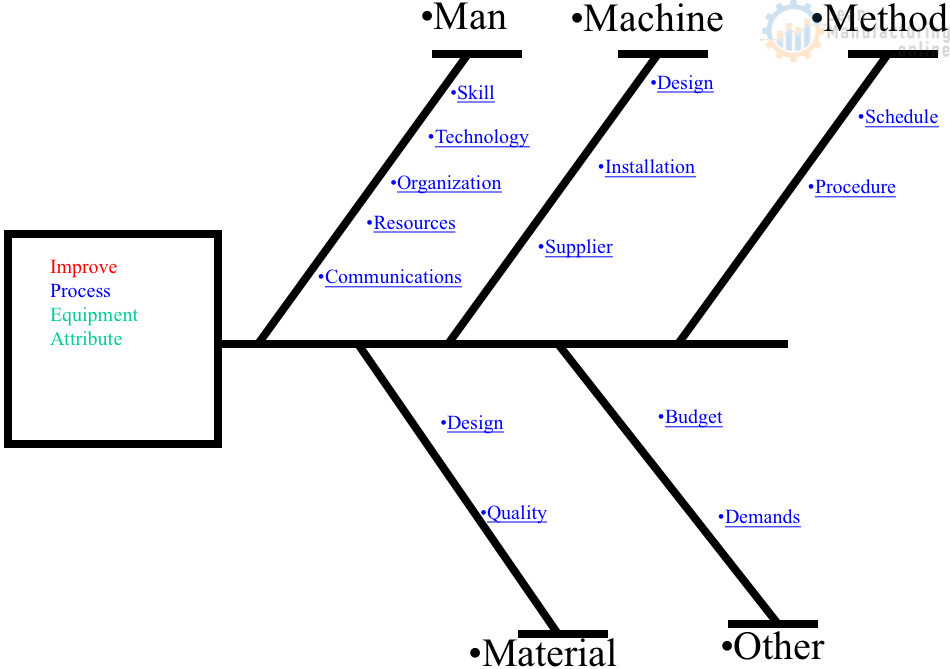
4M Analysis Process: Root Cause Guide for Manufacturing
Learn how to use 4M Analysis to find manufacturing root causes across People, Machine, Method, and Material with diagrams, examples, and checklist.